

14/11/2026 · Football, Streaming Platforms
MLS 2026: Who Was Watching?
Which MLS regular season matches drew the biggest audiences in 2026, and how often Inter Miami was among them.
Nine of the 10 most-watched matches of the MLS 2026 regular season had one thing in common: Inter Miami CF. The tenth was a Los Angeles derby featuring LAFC. Eyeballr’s modelled estimates point to two players and two countries behind that pattern: Lionel Messi and Argentina, Son Heung-min and South Korea.
Across 510 regular season matches, Eyeballr estimates a combined live audience of 229,795,138 viewers worldwide. The United States supplied 71.5% of it. The other 28.5% is where the story gets interesting. It matters to any brand on a shirt or a pitch-side board, because that is the audience their logo travels to.
This article looks at who watched, where they were, and which brand categories they saw most.
One club, nine of the top 10
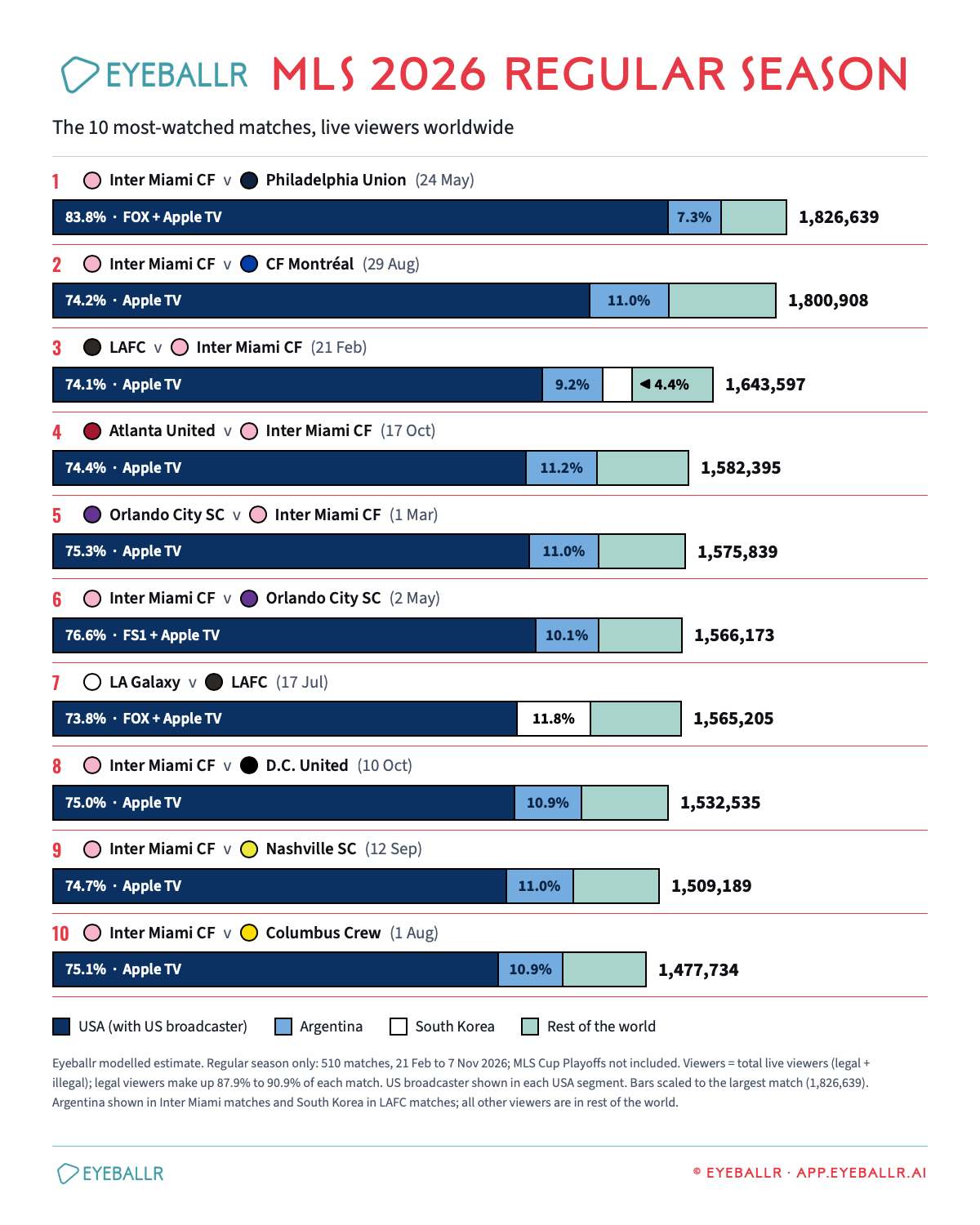
The most-watched match of the regular season was Inter Miami CF v Philadelphia Union on 24 May, with a modelled 1,826,639 live viewers worldwide. The tenth, Inter Miami CF v Columbus Crew on 1 August, drew 1,477,734. Only LA Galaxy v LAFC on 17 July, in seventh, broke Inter Miami’s run.
The pattern runs well beyond the top 10. Inter Miami’s 34 regular season matches averaged 1,267,715 viewers. Matches featuring neither Inter Miami nor LAFC averaged 358,463. That makes an Inter Miami match worth about three and a half times a typical MLS fixture.
Put another way, Inter Miami played in 6.7% of the season’s matches and accounted for 18.8% of its viewers. The most-watched match without Inter Miami or LAFC, Nashville SC v Atlanta United on 17 July, ranked 41st with 942,731 viewers. Every one of the 40 matches above it featured at least one of the two clubs.
That is not the footprint of a club. It is the footprint of a player. The viewing data cannot tell us why someone tuned in, but where they tuned in from makes Eyeballr’s reading clear: this is the Messi effect, and the evidence is in Argentina.
Argentina follows its captain
In each of the nine Inter Miami matches in the top 10, Argentina was the second-largest market after the United States. It supplied between 7.3% and 11.2% of viewers. In the one top 10 match without Inter Miami, Argentina’s share was 2.3%.
The season-long numbers say the same thing. Argentina averaged 135,151 viewers for an Inter Miami match and 18,544 for every other match, more than seven times as many. Inter Miami’s 34 matches delivered 34.2% of all Argentine viewing of the regular season. The biggest Argentine audience of the year was 198,466, for Inter Miami CF v CF Montréal on 29 August.
One caveat belongs here. Argentina’s total includes a larger share of illegal viewing than most markets: legal viewers were 65.1% of its season total of 13,421,874, against 89.4% across all markets. The appetite is real. Not all of it runs through official broadcasts.
Son and South Korea
The one match that broke Inter Miami’s hold on the top 10 tells the second story. LA Galaxy v LAFC on 17 July drew 1,565,205 viewers, and 184,659 of them, 11.8%, were in South Korea. It was the largest South Korean audience of the season.
LAFC is Son Heung-min’s club, and South Korea watches LAFC the way Argentina watches Inter Miami. South Korea averaged 110,294 viewers for an LAFC match and 20,251 for every other match, more than five times as many. Across LAFC’s 34 matches, South Korea supplied 12.7% of all viewers. For LAFC v San Diego FC on 15 August it was 16.9%.
The effect lifts the club as a whole. LAFC’s matches averaged 868,746 viewers, about 2.4 times the 358,463 average for matches without either star club. Unlike Argentina, South Korea’s audience is overwhelmingly legal, at 90.0%.
The two stories met once in the regular season. LAFC v Inter Miami CF on the opening day, 21 February, drew 1,643,597 viewers and ranked third. Argentina supplied 9.2% and South Korea 4.4%.
Canada, Brazil and Europe
Canada is the league’s second market, and it is not built on one star. Canada supplied 13,449,231 viewers across the season, 5.9% of the total and narrowly ahead of Argentina (13,421,874) and South Korea (13,389,402). Fewer than 60,000 viewers separate the three. The difference is in how the audience is spread. Matches with no Canadian club accounted for 64.9% of Canadian viewing, and 92.0% of Canada’s audience was legal. Canada watches the league, not only its own teams. Its five biggest audiences were all Vancouver Whitecaps FC matches, led by 152,071 for Vancouver Whitecaps FC v LAFC on 1 August.
Brazil watches Messi too, in much smaller numbers. Brazil was the sixth-largest market, behind Mexico (6,061,021), with 2,411,121 viewers, 1.0% of the season total and less than a fifth of Argentina’s. It averaged 16,010 viewers for an Inter Miami match and 3,922 for other matches, about four times as many. Its biggest audience was 34,318, for Inter Miami CF v Atlanta United on 5 September. As in Argentina, legal viewers were a smaller share, at 65.0%.
Europe is small, and the clock is part of the reason. Eyeballr’s 55 European markets combined for 7,141,631 viewers, 3.1% of the season total and just over half of Canada’s figure alone. The United Kingdom led with 1,743,705, followed by Germany (1,192,071), Spain (840,821), France (769,324) and Italy (525,609). Of the 510 matches, 431 kicked off at 22:00 UTC or later, and 259 of those after midnight UTC. Europe’s share of viewers was 4.1% for the 79 earlier kick-offs and 2.8% for the after-midnight ones. When Europe did watch, it watched Messi: its five biggest audiences were all Inter Miami matches, peaking at 45,764.
What those viewers saw
An audience is only half of a sponsorship. The other half is what is on screen. Eyeballr tracks the brands visible in the broadcast, whether on kit, on pitch-side and LED boards, or anywhere else in the stadium, and groups them by category. Across 405 regular season matches analysed, that covered 1,093 brands in 23 categories.
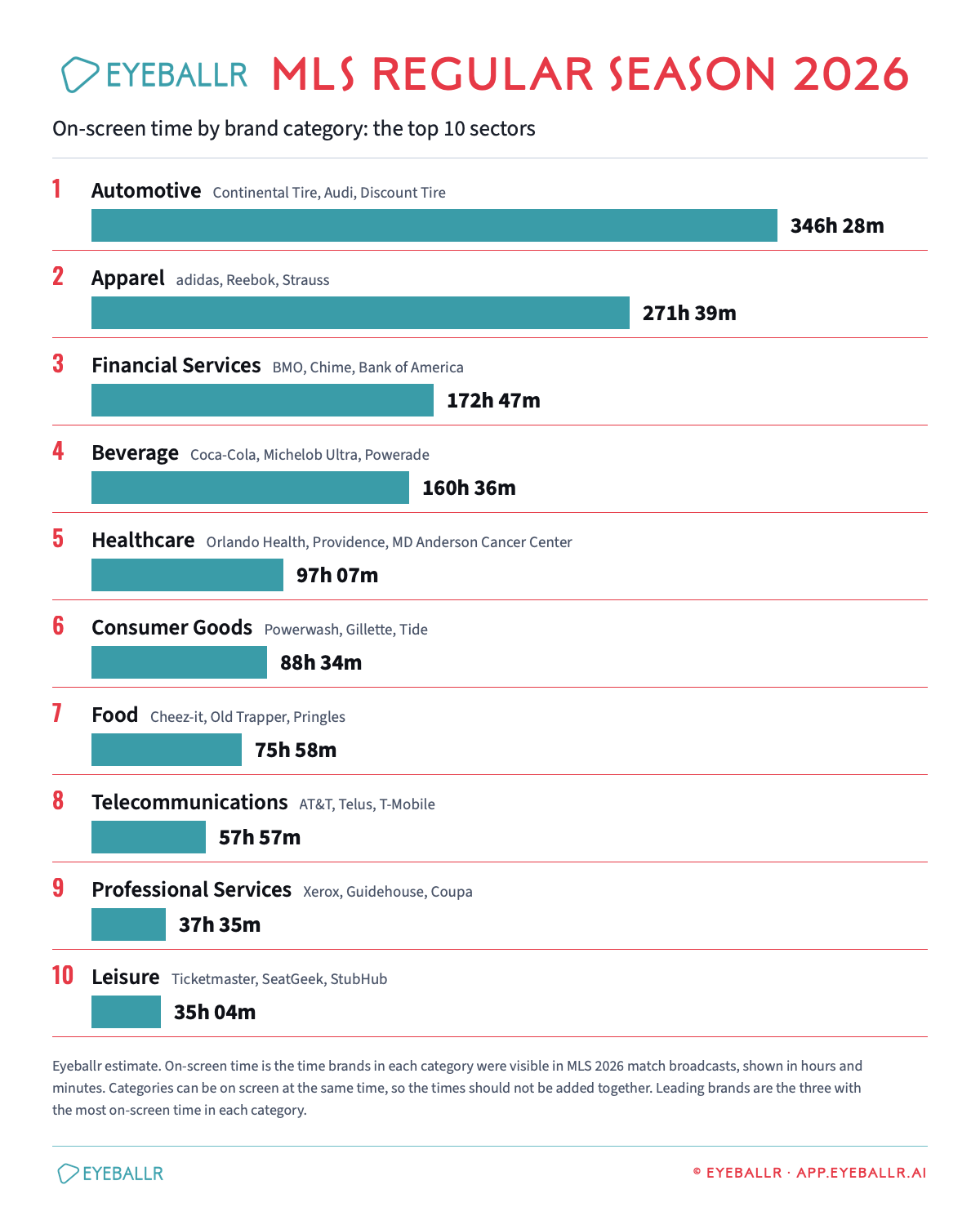
Automotive leads with 346h 28m of on-screen time, and one brand does almost half the work. Continental Tire accounted for 171h 58m, 49.6% of the category, ahead of Audi and Discount Tire.
Apparel is second with 271h 39m, and it is close to a one-brand category. adidas accounted for 262h 13m, or 96.5%.
Financial Services is third with 172h 47m, and it is the opposite case: 115 different brands share the time. The leader, BMO, had 29h 51m. Only Food has more brands (123), with less than half the on-screen time.
Beverage is fourth with 160h 36m, led by Coca-Cola (50h 20m) and Michelob Ultra (33h 44m).
Healthcare is fifth with 97h 07m, a distinctly American entry. Its leading brands are hospital systems: Orlando Health, Providence and MD Anderson Cancer Center.
Consumer Goods (88h 34m), Food (75h 58m), Telecommunications (57h 57m), Professional Services (37h 35m) and Leisure (35h 04m) complete the top 10. Gambling sits outside it, in 15th place with 22h 57m.
Two more things stand out. First, the stadium does most of the work: in-venue assets such as boards and signage made up 89.7% of all brand on-screen time, and kit 10.3%. Second, the Canadian audience has Canadian brands waiting for it. BMO leads Financial Services, and Telus is second in Telecommunications with 18h 34m, behind AT&T (26h 42m).
Categories can be on screen at the same time, so category times should not be added together.
What it means for brands
The audience is not evenly spread, so the value is not either. Two clubs carry most of the league’s international reach. Across Inter Miami’s matches, 10.7% of viewers were in Argentina. Across LAFC’s, 12.7% were in South Korea. A board at those matches is working in markets a typical MLS fixture barely reaches.
Know your category before you buy. In Automotive and Apparel, a single brand holds about half of the on-screen time or more. In Financial Services, 115 brands compete for it. Standing out means something different in each.
Match the market to the brand. Canadian brands are already visible to the league’s second-largest audience. Brands with business in Argentina or South Korea have a direct route to those viewers through two clubs. Brands looking for Europe should know it accounted for 3.1% of viewers this season.
The point is the same in every case. Reach and visibility are different measures, and a sponsorship needs both: how many people watched, where they were, and whether the brand was on screen when they did. Eyeballr measures all three.
About the data
All figures are Eyeballr modelled estimates, not audited or official broadcaster figures. Viewership covers the MLS 2026 regular season only: 510 matches from 21 February to 7 November 2026. The MLS Cup Playoffs are not included. Viewers are total live viewers, legal and illegal viewing combined. Season and market totals are the sum of match audiences, so a person who watched several matches is counted for each. Legal viewers made up 89.4% of the season total and between 87.9% and 90.9% of each top 10 match.
On-screen time is an Eyeballr estimate of the time brands in each category were visible across 405 regular season matches analysed, shown in hours and minutes. Categories can be on screen at the same time, so their times should not be added together.