
The Sporting World’s Most Powerful League
The English Premier League’s global power comes from a combination of quality and structure that maximises reach and relevance across time zones. In its 30+ years of existence, the league showcases many of the top globally recognised sports clubs (Manchester United, Liverpool, Arsenal, Chelsea, Manchester City & Tottenham Hotspur: ‘the big six’), the world’s best players and intense rivalries, which guarantees emotionally charged, high-stakes fixtures almost every weekend. The league’s scheduling strategy layers those games into repeatable premium windows, such as the UK Saturday lunchtime and Sunday late-afternoon slots, prime time for one of Europe, Asia or the Americas, turning each televised game into a global event for fans and sponsors alike.
Eyeballr has interrogated its data across the first half of the 2025/26 season, and one broadcast window clearly stands apart as the Premier League’s most powerful time slot: Saturday 12:30 (UK time). That slot isn’t seen as the premium slot in the UK, however it has delivered an average of around 16.5 million total viewers per match so far – comfortably ahead of other premium slots.
Global Audience Capture Strategy
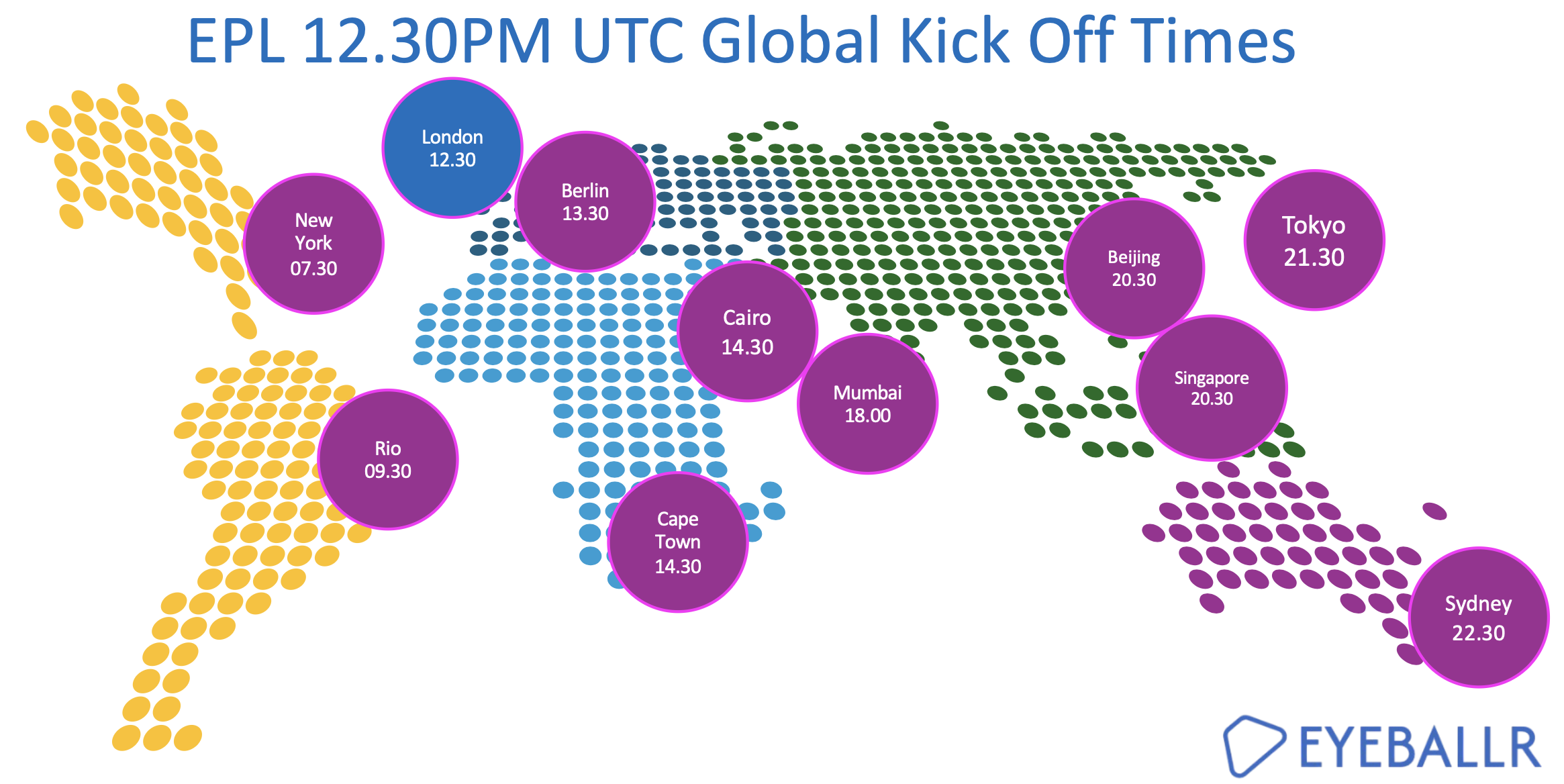
The 12:30PM UTC Saturday kick-off slot is the cornerstone of the Premier League’s international appeal, designated as a high-value broadcast package. This time slot successfully captures a massive worldwide audience through the following distribution:
- Prime Time in Asia: This time is intentionally structured to fall within prime-time viewing hours (early evening to late evening) across crucial East and Southeast Asian markets, including China and Japan. This maximises viewership in the world’s most populated regions.
- Morning in the Americas: The early start converts to morning slots in the United States and Canada (e.g., 7:30 AM ET). This allows matches to be viewed during breakfast hours, contributing to record-breaking U.S. viewership figures.
- Convenient Afternoon Viewing: The slot ensures afternoon viewing across major markets in Africa and the Middle East.
- Global Reach: The Premier League is broadcast to 188 countries worldwide, making the 12:30 PM UTC match the first widely available live fixture of the weekend for most of the world.
By contrast, traditional showcase windows such as ‘Super Sunday’ 16:30 PM UTC and Saturday 17:30 PM UTC average roughly 9.2 million and 8.1 million viewers per game respectively, still strong, but clearly secondary to the consistency and scale of 12:30PM. This makes Saturday lunchtime in the UK the single most reliable broadcast slot for building global appointment viewing around the Premier League.
The Biggest Days of the Season So Far
Looking at whole matchdays rather than individual games reveals how the schedule can turn certain weekends into mini global media festivals. The standout matchday so far is Saturday 20 September 2025, which delivered around 59.5 million total viewers across seven fixtures, making it the strongest single round of the season to date. That day was anchored by the 12:30 Merseyside derby, Liverpool vs Everton, which alone drew just under 30 million viewers, illustrating how placing a high-intensity rivalry in the best-performing global slot can transform the entire round’s commercial value. Other games on the same day, including Manchester United vs Chelsea at 17:30 and a series of solid 15:00 kick-offs, layered volume on top of that early peak.
Several other matchdays emerged as major global viewing moments: 27 September 2025 (circa 51 million total viewers), 8 November 2025 (circa 47 million), 30 November 2025 (circa 45 million), and 4 October 2025 (circa 43 million). In each case, a marquee game often involving Manchester United, Liverpool, Arsenal, Chelsea or Tottenham showcased in a premium slot (12:30, 16:30 or 17:30) and drags the entire round upwards. These are the days when the Premier League effectively behaves like a global tournament in microcosm, with multiple fixtures stacking audience attention across a single weekend.
The fixtures that move the needle
Within those slots and matchdays, a handful of fixtures stand out as audience superchargers. The single biggest game so far is Tottenham Hotspur vs Manchester United in the Saturday 12:30 slot on 8 November 2025, which generated approximately 31.8 million total viewers. That one game outperformed the average of almost every other slot on its own, underlining how the right combination of global brands in the right window can create outsized impact.
Other particularly strong fixtures in the early slot are Brentford vs Manchester United and Arsenal vs Aston Villa. Each of these games comfortably cleared the 10 million viewer mark, and in several cases pushed well beyond, helping to define both the strongest weekend totals and the perception of those kick-off times as “must-watch” windows.
Manchester United and Liverpool as the giants of the Premier League, and English football over the last 50 years, in particular appear repeatedly among the top-rated fixtures, often away from the traditional 15:00 block and into more commercially curated slots. When those clubs are paired with other ‘big six’ sides or local rivals and placed into 12:30 or 16:30, the audience curve bends sharply upward – and with it, the value of every logo and brand that sits in and around the broadcast. The Liverpool vs Manchester United match in the 16.30 slot on Sunday 19th October earned around 22 million global viewers, if this was placed at the Saturday 12.30 time slot, it would comfortably be the most viewed televised soccer match outside of the Champions League Final or an El Classico match scheduled at the best kick off time for a global audience.
Why This Matters
For the Premier League and its clubs, these audience dynamics translate directly into sponsor value. Every 12:30 Saturday broadcast is effectively a ready-made global media buy, delivering tens of millions of impressions in a tightly focused circa 100‑minute window across multiple time zones. Because these slots recur throughout the season, sponsors are not just buying one moment – they are buying a repeating pattern of global visibility that compounds over time.
League-level partners benefit from blanket association with these moments. Whenever a blockbuster 12:30 fixture spikes the global audience, their branding is present around the competition identity: in opening and closing sequences, in broadcast graphics, on interview backdrops and across official digital and social clips that will continue to circulate long after the final whistle. That amplification effect is heightened on the season’s biggest matchdays, such as 20 September or 27 September, where total round audiences reach 50-60 million viewers and every piece of official content carries those same sponsor touchpoints.
For club partners – shirt sponsors, front-of-shirt brands, sleeve sponsors, training wear partners and stadium advertisers – the fixture list becomes a strategic asset. Clubs that are repeatedly scheduled into the Saturday 12:30 window, especially against other major teams, deliver a far higher number of premium-quality impressions per season than those whose games are concentrated in routine 15:00 slots. That helps explain why certain front-of-shirt deals and LED packages command a premium: they are not just tied to a club, but to a portfolio of high-performing broadcast slots.
For media and broadcast professionals, the lesson is clear: slot strategy is sponsor strategy. The data from the 2025/26 season so far demonstrates that the world’s largest Premier League audiences are not random – they are concentrated in specific windows, built around specific clubs and storylines, and they pay back league and club sponsors every time the ball is kicked.
How Eyeballr Compiles This Data
Eyeballr data is agnostic of medium and market. Data is included for English Premier League matches, consumed on any device, TV network, OTT platform, streaming service or mobile app. The data is segmented by geography, meaning you’re seeing the full picture, across all televised matches. Eyeballr integrates open-source intelligence, direct streaming, broadcaster and YouTube data, alongside proprietary AI modelling to measure and validate major sports broadcast audiences. For the EPL, this includes aggregating data from international rights holders, analysing digital stream performance.
Get ahead of the pack and learn more about the Eyeballr approach to sports broadcast viewership by emailing us at: stephen@eyeballr.ai
Comments are closed